On Easter morning, according to the Gospel of St. John, our Blessed Saviour said to Mary Magdalene: Do not cling to me, for I have not yet ascended to the Father (20:17). That is: Do not imagine, because you can see me...
Homily for Easter Sunday 2014
From the beginning, the proclamation of the resurrection of the Lord is inseparable from the memory of his appearances. In Luke we see this process right at its beginning. When the disciples on the road to Emmaus, after seeing the risen Lord, go back to the eleven apostles, they are told: ‘It is true, the Lord has risen, and he has appeared to Simon!’ (Luke 24:34)
St Paul, writing to the Corinthians, gives...
Homily for the Easter Vigil 2014
The beginning of the new life, the life of the Risen Lord, is very like the beginning of his earthly life. Before developing this theme, let us pause there a little. The Son of God entered the world in poverty and obscurity. In St Matthew’s Gospel, he is a baby in a refugee family, and spends his earliest years in exile. His life is short, he has no children, he dies a condemned criminal, and his mission ends in failure. That is his...
Homily for Good Friday 2014
‘My God, my God, why have you abandoned me?’ These words of Jesus have seared themselves on the memory of the Church. Matthew and Mark record them in the precise Aramaic words that Jesus used. They are the opening words of Psalm 22. Taking their cue from these words of Jesus, all the evangelists to a greater or lesser degree interpret the Passion of Jesus in the light of this psalm, including...
Homily for Holy Thursday 2014
Pentecost Lectures 2014
“IMMORTALITY IN QUESTION”
The 2014 Pluscarden Pentecost Lectures – given by Professor Carol Zaleski,
Professor of World Religions at Smith College in Northampton, Massachusetts, USA
10th – 12th June 2014 at Pluscarden Abbey
1. Tuesday 10 June at 2.45 pm
The problem with immortality – we don’t know how to think about it
2. Wednesday 11 June at 10.15 am
The problem with heaven – imagination can’t grasp it
3. Wednesday 11 June at 2.45 pm
The problem with hell – love can’t bear it
4. Thursday 12 June at 10.15 am
The problem with purgatory – Christians can’t agree on it
Each year the Abbot and Community of Pluscarden Abbey sponsor a series of four lectures by an invited Theologian on an aspect of Catholic Theology. Previous Lecturers have included Fr Vincent Twomey S.V.D., Professor Lewis Ayres, Professor John Haldane, Fr Aidan Nichols OP, Fr Thomas Weinandy OFM Cap, Fr Anthony Meredith SJ, Fr Paul McPartlan and Fr Tom Herbst OFM. The Lectures are held on the Tuesday, Wednesday and Thursday after Pentecost in St Scholastica’s Retreat House at the Abbey. They are open to all who wish to attend and are free. Limited accommodation is available at the Abbey and those who wish to stay should book as soon as possible. There are also many places to stay in the Elgin area: contact the local tourist office: 01343 542666.
The Lecturer

Carol Zaleski is the Professor of World Religions at Smith College, where she also chairs the Department of Religion. She earned her B.A. from Wesleyan University and her M.A. and Ph.D. in the study of religion from Harvard University. She has been teaching philosophy of religion, world religions, and Catholic thought at Smith College since 1989. Zaleski is the author of Otherworld Journeys: Accounts of Near-Death Experience in Medieval and Modern Times and The Life of the World to Come (both Oxford University Press); she is also a columnist and editor-at-large for The Christian Century. She has co-authored, with her husband Philip Zaleski, Prayer: A History (Houghton Mifflin), The Book of Heaven (Oxford), The Book of Hell (forthcoming, Oxford), and a group biography of the Inklings—C.S. Lewis, J.R.R. Tolkien, Charles Williams and their circle (forthcoming, Farrar, Straus & Giroux). Together, Carol and Philip Zaleski are long-time friends of Pluscarden Abbey and oblates of the twin Benedictine communities at Petersham; and they are closely associated with the British Catholic journal Second Spring and its founding editors Stratford and Léonie Caldecott.
The Lectures: “Immortality in Question”
Introduction

With few exceptions, icons of our Lord’s Descent into Hell have a curious detail in common: they show Christ seizing Adam by the wrist rather than by the hand, as he pulls our first parents out of the cave, or the jaws, or the prison, of death. It’s a small detail but, as these four lectures will suggest, it captures in miniature precisely what is distinctive about the Christian understanding of immortality.
My premise is that this distinctive understanding of immortality is not widely understood -- and in some quarters is actually under siege. In these lectures, I will be considering problems that are typically raised by Christians as well as non-believers, occasionally looking over the fence at other religions whose traditions may enrich our understanding, and reflecting upon solutions that become available when we seek to think with the mind of the Church.
Lecture 1. The problem with immortality – we don’t know how to think about it

The expression ‘immortality of the soul’ went out of fashion in the mid-twentieth-century, but it is making a comeback, thanks in no small part to Joseph Ratzinger’s magisterial 1977 book Eschatology: Death and Eternal Life. Christian theological anthropology affirms the creatureliness as well as the dignity of the human person and places the hope for immortality wholly in the hands of our loving Redeemer.
Lecture 2. The problem with heaven – imagination can’t grasp it

If heaven seems boring, as the cliché has it, it is due to an atrophy of our reason, imagination, and love; restless until our hearts rest in God, we cannot help but form an inadequate picture of divine peace. Some seek a cure for heaven-fatigue in poetry, but the best cure is a poetic life, living by a Rule not of our own making, by the Church’s rather than the world’s clock, in the bright shadow of eternity.
Lecture 3. The problem with hell – love can’t bear it

Most serious Christians have sought to affirm at once God's universal salvific will and our creaturely freedom to accept or reject His love. Thus Hans urs von Balthasar could ‘dare to hope that all men will be saved’ while C. S. Lewis, no less hopeful, maintained that hell is ‘locked from the inside.’ This lecture will consider the present state of the question as Christians grapple with the problem of hell.
Lecture 4. The problem with purgatory – Christians can’t agree on it

Purgatory is a belief founded on the practice of care for the dead, present in germ throughout world religions, fully articulated (and discriminated from ‘hell lite’) by the Catholic tradition, rejected by the Reformers, but resurfacing wherever suppressed (consider Hamlet and The Four Quartets). Christians of many confessions are coming to see the wisdom of C.S. Lewis’s observation that ‘our souls need purgatory’; and this development brings with it new opportunities for ecumenical understanding.
For further information or to book accommodation, contact the Abbey.
Easter audio CD

There is a new audio CD of chant from Pluscarden Abbey available from our shop. The twenty-five items were recorded in the Abbey church between 2010 and 2012, and include the most beautiful music of Easter. There is a 32-page booklet with it, giving the full text and translation, together with a commentary on every piece.
2013 Pentecost Lectures
“REVELATION AND REASON”
THE THOUGHT OF JOSEPH RATZINGER/BENEDICT XVI
The 2013 Pluscarden Pentecost Lectures – given by Fr Vincent Twomey S.V.D.,
Professor of Moral Theology at the Pontifical University of St Patrick’s College, Ireland
21st – 23rd May 2013 at Pluscarden Abbey, near Elgin
1. Tuesday 21st May at 2.45 pm
“Man’s Search for the Face of God”
[Ratzinger on Philosophy, Prophecy and Religion]
2. Wednesday 22nd May at 10.15 am
“God’s unveiling of His face”
[Ratzinger on Revelation]
3. Wednesday 22nd May at 2.45 pm
“The Sensorium of Truth, Goodness, and Beauty”
[Ratzinger on Primordial Conscience]
4. Thursday 23rd May at 10.15 am
“Orthodoxy as Divine Worship”
[Ratzinger on Reasonable Worship (Rom 12:1)]
Each year the Abbot and Community of Pluscarden Abbey sponsor a series of four lectures by an invited Theologian on an aspect of Catholic Theology. Previous Lecturers have included Professor John Haldane, Fr Aidan Nichols OP, Fr Thomas Weinandy OFM Cap, Fr Anthony Meredith SJ, Fr Paul McPartlan and Fr Tom Herbst OFM. The Lectures are held on the Tuesday, Wednesday and Thursday after Pentecost in St Scholastica’s Retreat House at the Abbey. They are open to all who wish to attend and are free. Limited accommodation is available at the Abbey and those who wish to stay should book as soon as possible. There are also many places to stay in the Elgin area: contact the local tourist office: 01343 542666.
The Lecturer
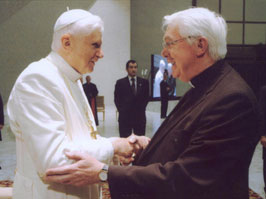
Fr D. Vincent Twomey holds a PH.D. in Theology and is a Professor of Moral Theology at the Pontifical University at St Patrick's College in Ireland. He is the author of several books including Benedict XVI. The Conscience of Our Age: A theological Portrait (San Francisco: Ignatius Press, 2007). A former doctoral student of Joseph Ratzinger and long time friend of the Pope, he felt the need to respond to the common question he read and heard often after Ratzinger’s papal election, “What kind of person is the new Pope?” So often Fr Twomey had read in the past false depictions of both the man, and his thought and writings, especially the image presented by the media as a grim, hard-line, enforcer, “panzer Cardinal”, etc. In this book Fr Twomey offers a unique double-presentation of the man, Pope Benedict XVI – a “theological portrait” that encompasses both an overview of the writings, teachings and thought of the brilliant theologian and spiritual writer, as well as the man himself, and his personality traits and how he communicates with others.
Fr Twomey is the author of several other books and articles, including his most recent acclaimed study on the state of Irish Catholicism, The End Of Irish Catholicism? Other publications include Apostolikos Thronos: The Primacy of Rome as reflected in the Church History of Eusebius and the historico-apologetic writings of Saint Athanasius the Great (Münster, Westphalia 1981); Christianity and Neoplatonism: Proceedings of the First Patristic Conference, Joint Editor with Thomas Finan (Dublin: 1992); Scriptural Interpretation in the Fathers: Letter and Spirit: Proceedings of the Second Patristic Conference, Joint Editor with Thomas Finan (Dublin 1995); Moral Theology after Humanae Vitae: Fundamental issues in moral theory and sexual ethics (Dublin: Four Courts Press, Spring 2010); The Mystery of the Holy Trinity in the Fathers of the Church, co-edited with Lewis Ayres (Dublin: Four Courts Press, 2007).
The Lectures: “Revelation and Reason” The Thought of Joseph Ratzinger/Benedict XVI
“The revelation of God’s name, which began in the burning bush, comes to completion in Jesus (cf. Jn 17:26)” (Jesus of Nazareth: The Infancy Narratives, Joseph Ratzinger/Pope Benedict XVI, page 30).

“[Ratzinger] has written on almost every theological subject touching on the faith, morality, and Church and State. He is as open to beauty as he is to truth. He lives outside himself. He is not preoccupied with his own self. Put simply, he does not take himself too seriously.
Once he asked me gently about the progress of my thesis. I told him that I thought there was still some work to be done. He turned to me with those piercing but kindly eyes, saying with a smile: ‘Nur Mut zur Lücke’ (Have the courage to leave some gaps). In other words, be courageous enough to be imperfect.
On reflection, this is one of the keys to Ratzinger’s character (and also to his theology; in particular his theology of politics): his acceptance that everything we do is imperfect, that all knowledge is limited, no matter how brilliant or well read one may be. It never bothered him that in a course of lectures he rarely covered the actual content of the course. His most famous book, Introduction to Christianity, is incomplete. Ratzinger knows in his heart and soul that God alone is perfect and that all human attempts at perfection (such as political utopias) end in disaster.
The only perfection open to us is that advocated by Jesus in the Gospel: ‘You, therefore, must be perfect, as your heavenly Father is perfect’ (Mt 5:48), he who ‘makes his sun rise on the evil and on the good, and sends rain on the just and on the unjust’ (Mt 5:45). Love of God and love of neighbour: that is the secret of Pope Benedict XVI, and that will be the core of his universal teaching.” (Introduction, Benedict XVI. The Conscience of Our Age)
Lecture 1: Man’s Search for the Face of God
“Right faith orients reason to its openness to the divine, so that, guided by love for the truth, it can know God more closely. The initiative for this path is with God who has put in man’s heart the search for his Face. Hence, part of theology, on one hand, is humility that lets itself be ‘touched’ by God, and on the other hand, discipline that is linked to the order of reason, which preserves love from blindness and which helps to develop its strength for seeing.” (Benedict XVI: Address to Ratzinger Prize Winners, July 1, 2011).
Lecture 2: God’s Unveiling of His Face
“What did Jesus actually bring, if not world peace, universal prosperity, and a better world? What has he brought? The answer is very simple: God. He has brought God! He has brought the God who formerly unveiled his countenance gradually first to Abraham, then to Moses and the Prophets, and then in the Wisdom Literature—the God who revealed his face only in Israel, even though he was also honoured among the pagans in various shadowy guises. It is this God, the God of Abraham, Isaac, and Jacob, the true God, whom he has brought to the peoples of the earth. “[Jesus] has brought God, and now we know his face, now we can call upon him. Now we know the path that we human beings have to take in this world. Jesus has brought God and with God the truth about where we are going and where we come from: faith, hope, and love.” (Benedict XVI: Jesus of Nazareth Vol. 1, Bloomsbury 2007, p. 44)
Lecture 3: The Sensorium of Goodness, Truth and Beauty
Primordial conscience is “the window that for human beings opens onto a view of the common truth, which establishes and sustains us all and so makes community of decision and responsibility possible thanks to the common ground of perception.” (Joseph Cardinal Ratzinger, Wahrheit, Werte, Macht, Prüfsteine der pluralistischen Gesellschaft, Freiburg, 1993, p. 32, Twomey translation)
Lecture 4: Orthodoxy as Divine Worship
“‘I appeal to you therefore, brethren, by the mercies of God, to present your bodies as a living sacrifice, holy and acceptable to God, which is your spiritual worship’ (Rom. 12:1). [St Paul speaks] “of the desire for true worship, in which man himself becomes the glory of God, living adoration with his whole being.” (Benedict XVI: Catechesis on ‘spiritual’ worship, Jan. 7, 2009)